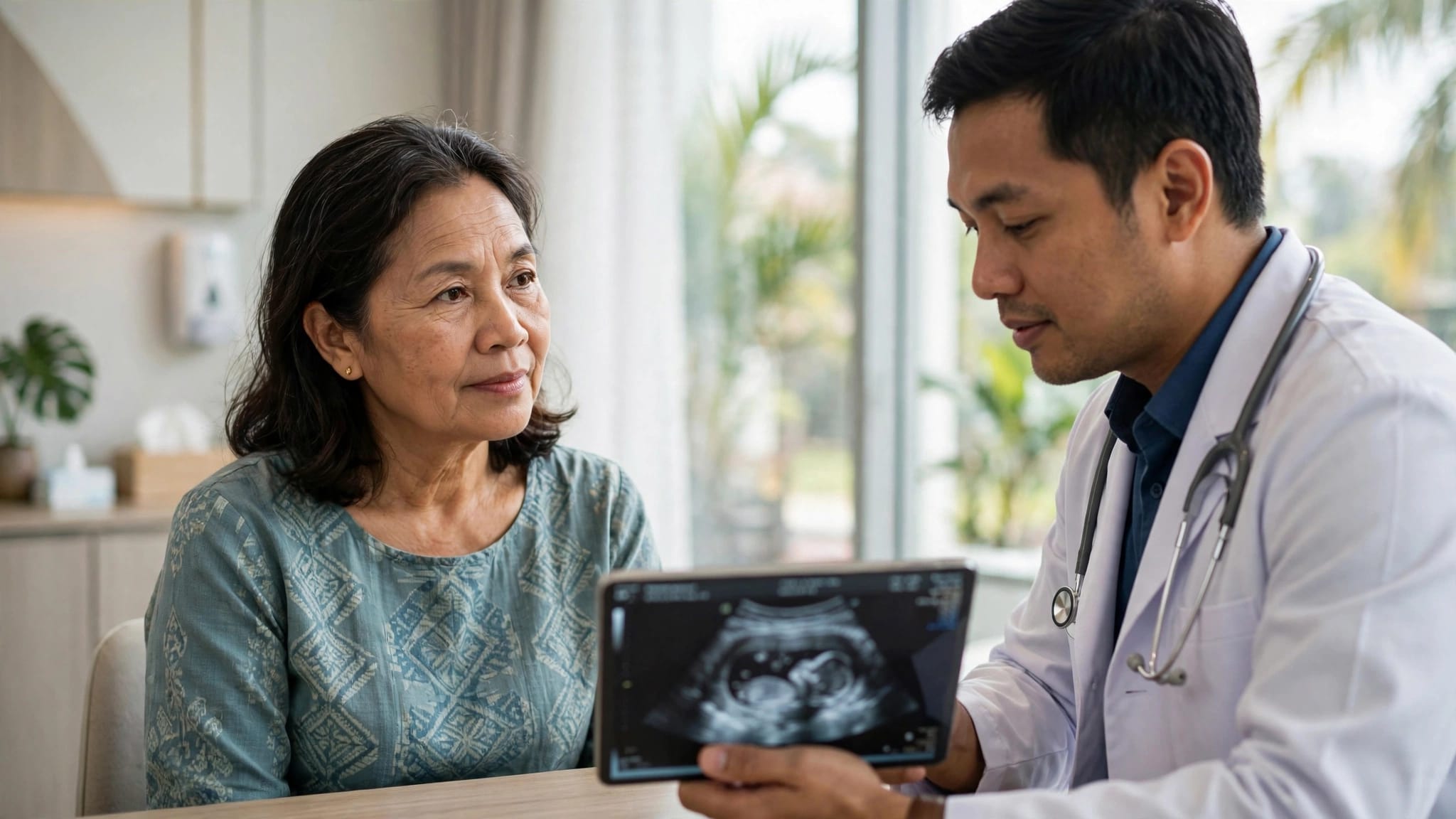
A cancer stage can sound like a verdict when you first hear it. In reality, it is a shared map that helps your healthcare team understand where the cancer is and plan the next steps.
Understanding lung cancer stages can help you prepare for an oncology consultation, but stage alone can’t predict your individual outcome. Your cancer type, scan results, biopsy findings, overall health, and response to care also matter.
Start by asking which type of lung cancer you have and how lung cancer staging was assigned.
Key Takeaways
- Lung cancer stage describes the primary tumor, nearby lymph nodes, and whether cancer has spread to distant areas; it helps guide treatment discussions but does not predict an individual outcome on its own.
- Non-small cell lung cancer uses TNM categories and numbered stage groups from 0 to IV, while small cell lung cancer is commonly described as limited-stage or extensive-stage disease.
- Clinical staging is based on scans, biopsies, and lymph-node tests, while pathologic staging after surgery may provide more detailed information.
- Treatment depends on cancer type, stage, biomarkers, lung function, overall health, treatment goals, and personal preferences—not stage alone.
- Keep copies of your medical records and ask direct questions about your diagnosis, treatment options, likely benefits, costs, and whether a second opinion may help.
What a lung cancer stage tells your healthcare team
Lung cancer staging describes the size and location of the primary tumor, whether it has reached nearby lymph nodes, and whether it has spread to distant parts of the body. This information helps your team discuss treatment options that fit your situation.
For non-small cell lung cancer, the most common broad type, doctors use numbered stages from 0 to IV. Small cell lung cancer is often grouped as limited-stage or extensive-stage disease. These approaches are different parts of the overall staging system.

Why your stage can change after surgery
Your initial assessment usually uses clinical staging. Your doctor estimates it from a CT scan, PET scan for cancer, MRI scan, biopsy results, and tests of lymph nodes.
If you have cancer surgery, the laboratory can examine the removed primary tumor and regional nodes. This creates pathologic staging, which may be more detailed. A changed result after surgery does not necessarily mean the earlier assessment was wrong. Surgery may reveal information that scans could not show.
Ask whether your report states clinical staging or pathologic staging, and ask which current staging edition your hospital uses.
How the TNM system classifies lung cancer
For non-small cell disease, doctors use the TNM system to assess the primary tumor and explain lung cancer staging. You can read a patient-friendly overview in Cancer Research UK’s TNM staging guide.
The current ninth edition of this staging system retains the tumour size categories used earlier, while adding detail for some lymph-node and metastatic patterns. The IASLC ninth-edition staging reference describes these updates in more technical terms.
T describes the primary tumor
“T” records the size and location of the primary tumor. Tumor size categories range from T1 for tumours up to 3 cm to T4 for those over 7 cm. T2 tumours are larger than 3 cm but no more than 5 cm, while T3 tumours are over 5 cm to 7 cm.
Size isn’t the only issue. A smaller primary tumor can receive a higher T category if it reaches the chest wall or main bronchus. The primary tumor’s final category reflects both size and local invasion, including involvement of the main bronchus or another lobe of the same lung.
N describes nearby lymph nodes
“N” tells you whether cancer cells appear in regional lymph nodes. N0 means no regional node spread was found. N1 involves lymph nodes close to the affected lung. N2 involves mediastinal lymph nodes in the centre of the chest, including mediastinal or subcarinal stations.
N3 describes nodes on the opposite side of the chest or above the collarbone. In the ninth edition, doctors distinguish one affected station of mediastinal lymph nodes from several stations. That distinction may affect the stage group and treatment discussion.
M describes distant metastasis
“M0” means scans show no distant metastasis. “M1” means cancer has spread outside the original chest area, forming secondary tumors in the other lung, brain, bones, liver, adrenal gland, or another site.
A single distant lesion and multiple areas of spread may be recorded as different patterns of secondary tumors. Your oncology team considers the location, number of sites, symptoms, and available treatments rather than using the M category alone.
Non-small cell lung cancer stage groups in plain language
Most lung cancers are non-small cell lung cancer (NSCLC). The staging system considers the primary tumor. The complete TNM combination, not tumour size alone, determines the group, so don’t assign a stage from size alone.
| Stage group | What it generally means |
|---|---|
| Stage 0 | Abnormal cells are limited to the airway lining and have not invaded deeper tissue. |
| Stage 1 lung cancer | Cancer is limited to the lung tissue, with no regional spread found. |
| Stage 2 lung cancer | The tumour may be larger, or cancer may involve nearby lymph nodes on the same side. |
| Stage 3 lung cancer | Cancer has spread within the chest, often to central chest nodes or nearby structures. |
| Stage 4 lung cancer | Cancer has spread to distant organs or areas outside the original chest region. |
Stage IA, IB, IIA, IIB, IIIA, IIIB, IIIC, IVA, and IVB add further detail. The letter is meaningful because it reflects tumour features, lymph-node sites, and metastasis patterns.
What stage 3 lung cancer means
Stage 3 lung cancer has spread within the chest but has not been classified as distant metastasis. It may involve mediastinal lymph nodes, the opposite side of the mediastinum, or nearby structures such as the chest wall and main bronchus.
Some stage III cancers can be considered for surgery as part of combined treatment. Others are treated with chemotherapy, radiotherapy, immunotherapy, or a planned combination. Resectability depends on the primary tumor’s position, node involvement, lung function, and specialist assessment.
What stage 4 lung cancer means
Stage 4 lung cancer has spread beyond the chest. This spread can create secondary tumors in the brain, bones, liver, or adrenal gland, although each person’s pattern differs.
The number and location of secondary tumors can affect care planning and outlook. Symptoms of lung cancer do not reliably reveal the stage or provide an individual life expectancy estimate.
A persistent cough, breathlessness, chest pain, fatigue, reduced appetite, weight loss, or hoarseness can occur for several reasons. Bone pain, headaches, weakness, seizures, or new confusion need prompt medical attention, especially if they appear suddenly.
Small cell lung cancer uses a different approach
Small cell lung cancer usually grows and spreads more quickly than NSCLC. Doctors may record TNM details, but treatment planning often uses two broader groups.
Limited-stage and extensive-stage disease
Limited-stage disease is confined to one side of the chest and nearby nodes, in a way that can usually fit within a radiotherapy field. Extensive-stage disease represents an advanced stage of spread beyond that area, sometimes involving secondary tumors at additional sites.
Treatment may include chemotherapy and radiotherapy for limited-stage disease. Extensive-stage cancer often requires systemic treatment, with radiotherapy used in selected situations. The NCI’s small cell lung cancer treatment information explains the established approaches in more detail.
These terms don’t match NSCLC stage groups exactly, but the same principle applies: stage helps your doctor set priorities and discuss realistic treatment goals.
Tests that confirm the stage and guide treatment
A cancer diagnosis starts with tissue. A biopsy identifies the cell type and provides material for pathology. CT scans show the primary tumor and surrounding chest structures. PET/CT can identify active lymph nodes or suggest secondary tumors elsewhere. Together, these tests support lung cancer staging and planning.
Your doctor may request a brain MRI, bronchoscopy, or ultrasound-guided sampling of lymph nodes. An EBUS procedure, for example, can sample some chest lymph nodes without open surgery when the result may change the treatment plan.

Biomarker testing adds another layer
For many cases of non-small cell lung cancer, especially adenocarcinoma and advanced disease, biomarker testing can look for gene changes such as EGFR, ALK, ROS1, BRAF, MET, RET, HER2, or KRAS. PD-L1 testing may also help guide immunotherapy discussions.
These results do not change your cancer stage. However, they can change which therapies may be suitable. A liquid biopsy may be useful in some situations, though it does not always replace a tissue biopsy.
Keep copies of your pathology report, scan reports, biopsy result, treatment summary, and medication list. If you need help preparing records for another specialist perspective, Explore Medical Report Review Support for information on coordinating medical documents.
Cancer treatment by stage is never one-size-fits-all
Stage gives your team a starting point, not a fixed prescription. The stages below use Arabic numbers, while formal reports may use Roman numerals or TNM categories. Your cancer treatment plan depends on the cancer type, the position of the primary tumor, molecular results, prior treatments, other medical conditions, lung function, and your preferences.
Common treatment paths by stage
For stage 1 lung cancer, surgery or precisely planned radiotherapy may be considered.
For stage 2 lung cancer, treatment options often include surgery plus chemotherapy before or after surgery. With stage 2 lung cancer, pathology and surgical findings may alter the plan.
For stage 3 lung cancer, chemotherapy and radiation therapy together, surgery within a combined plan, or immunotherapy after chemoradiation may be considered. With stage 3 lung cancer, resectability depends on anatomy, node involvement, chest wall involvement, and lung function.
For stage 4 lung cancer, systemic treatment may include targeted therapy, immunotherapy, chemotherapy, or combinations based on biomarkers and general health. Secondary tumors at multiple sites may make this approach appropriate. For stage 4 lung cancer, radiotherapy may help control symptoms in a specific painful or high-risk area.
The NCI’s guide to non-small cell lung cancer treatment outlines how treatment approaches vary by stage. For a broader explanation of possible approaches to discuss with your oncologist, Explore Cancer Treatment Options as an informational resource.
Questions to ask during an oncology consultation
Bring a family member if you want support taking notes. These questions can help you understand the diagnosis and treatment:
- What is my exact cancer type, clinical stage, and TNM classification?
- Which scans or sampling procedures assessed the lymph nodes and support this stage?
- Have biomarker and genetic testing results changed my options?
- What is my likely life expectancy, and how might treatment affect it?
- Is treatment intended to remove the cancer, control it, or relieve symptoms?
- What are the likely benefits, side effects, cost, and waiting time for each recommended approach?
- Would a cancer treatment plan review or another specialist opinion be reasonable before I decide?
When a second opinion or hospital comparison may help
You may want a cancer second opinion if the diagnosis is unclear, surgery would be extensive, stage 3 lung cancer treatment involves several methods, or biomarker results raise new questions. A second opinion for cancer can confirm the current recommendation, clarify the reasons behind it, suggest more assessment, or identify another medically appropriate approach.
It does not mean your current doctor is wrong. If treatment needs to begin quickly, ask your oncologist how to seek another opinion without causing an unsafe delay. Explore Cancer Second Opinion Support for coordination information if you are arranging records and specialist enquiries.
Different cancer hospitals may offer different thoracic specialists, systemic therapies, radiotherapy equipment, and molecular testing for people with stage 4 lung cancer. For stage 2 lung cancer, compare surgical expertise, pathology review, perioperative support, treatment availability, and waiting times. Ask for a written quotation that separates investigations, medicines, radiotherapy planning, procedures, admissions, and follow-up care.
If you are considering care outside Malaysia, compare the proposed specialist service, medical records required, timing, travel demands, and follow-up arrangements. Explore Overseas Hospital Options for hospital-enquiry and medical-travel coordination support. Overseas care or newer technology does not automatically produce a better outcome.
Frequently Asked Questions
Does lung cancer stage determine my life expectancy?
No. Stage provides important information about how far the cancer has spread, but it cannot predict an individual life expectancy by itself. Cancer type, biomarkers, overall health, treatment response, and other factors also matter.
What is the difference between clinical and pathologic staging?
Clinical staging is estimated from scans, biopsies, and lymph-node tests before treatment or surgery. Pathologic staging uses laboratory findings from tissue removed during surgery and may reveal details that scans could not show.
What does stage 4 lung cancer mean?
Stage 4 lung cancer means the cancer has spread beyond the original chest region to distant organs or areas. Treatment may include targeted therapy, immunotherapy, chemotherapy, radiotherapy for selected symptoms, or combinations based on biomarkers and general health.
Can biomarker testing change my lung cancer stage?
No. Biomarker results do not change the stage, but they may help identify treatments that could be suitable, particularly for some cases of non-small cell lung cancer. Your oncologist can explain which tests apply to your cancer type and treatment plan.
When might a second opinion be helpful?
A second opinion may help when the diagnosis is unclear, treatment involves several approaches, surgery would be extensive, or biomarker results raise new questions. Ask your oncologist how to arrange one without causing an unsafe delay in treatment.
A clearer stage supports better conversations
The next step is to understand your exact diagnosis and the evidence supporting your stage. Consider the primary tumor, node findings, and spread together, rather than relying on one number.
An individual life expectancy estimate can’t be taken from stage alone. Discuss it with your treating team, alongside treatment goals and personal preferences.
Keep your reports organised and ask direct questions. Confirm the treatment goal and seek clarification before making decisions. Clear information can help you take part in care without making assumptions from a stage number alone.
Medical disclaimer: This content is for general educational information only. It may not apply to every patient and is not medical advice, a diagnosis, or a treatment recommendation. Consult your own doctor, oncologist, or qualified healthcare professional before making medical decisions.