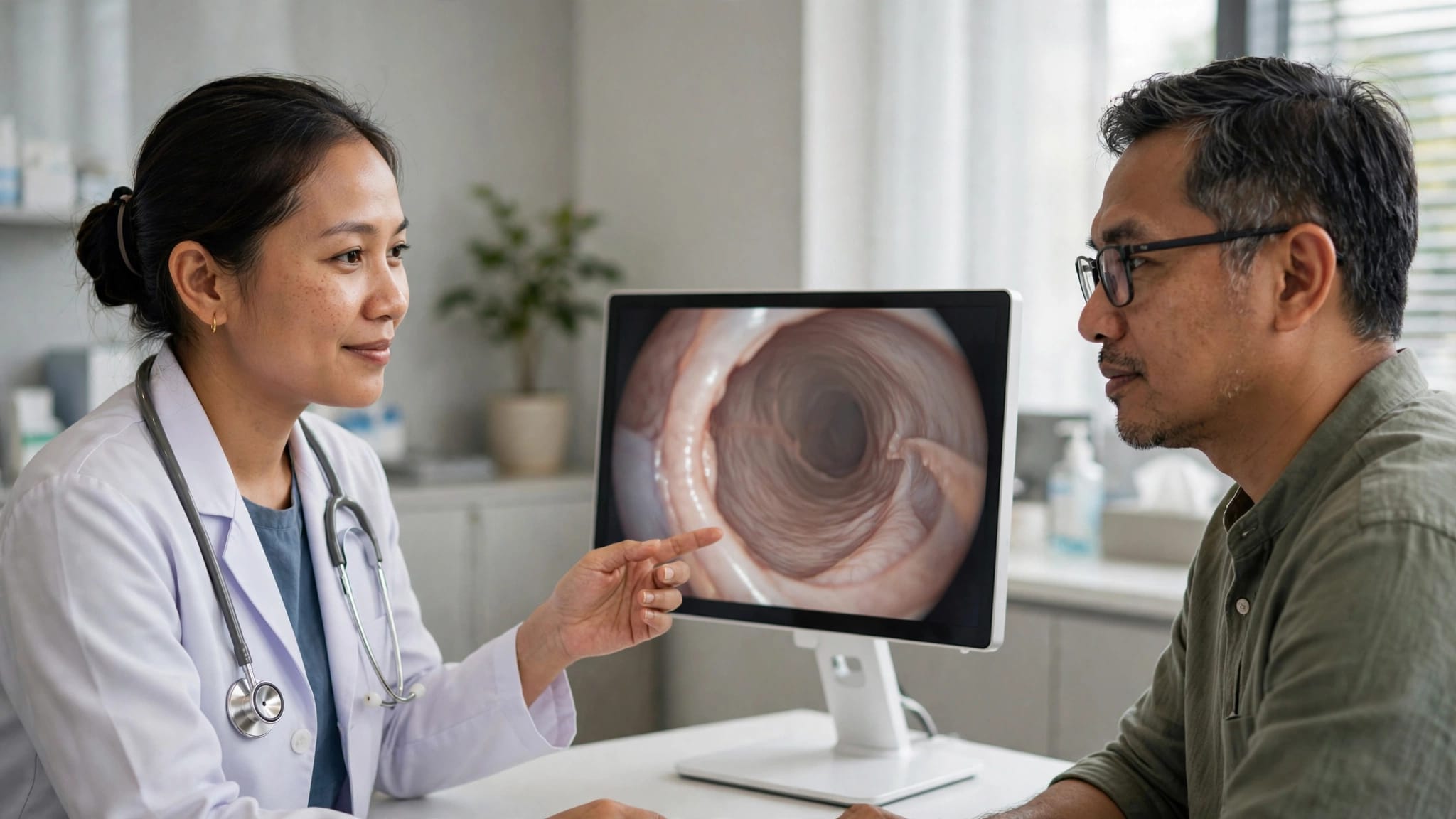
Waiting for thyroid biopsy results can make a few days feel much longer. Your thyroid FNA results may contain unfamiliar medical terms, but the pathology report uses the Bethesda System as a framework for categorizing the sample, not as a diagnosis.
Most nodules are benign, but an FNA samples cells rather than answering every question about a thyroid nodule. The category doesn’t determine thyroid cancer or cancer risk on its own. Your clinician reads it alongside your ultrasound findings, symptoms, medical history, and examination.
Start by understanding the category on your report, then discuss the result with the clinician managing your thyroid care.
Key Takeaways
- The Bethesda category on a thyroid FNA report classifies the cell sample; it does not determine your diagnosis or cancer risk on its own.
- Bethesda I means the sample was insufficient and often leads to a repeat ultrasound-guided FNA, while Bethesda II is generally reassuring but may still need ultrasound and clinical follow-up.
- Bethesda III and IV are indeterminate results that may require repeat sampling, molecular testing, specialist review, or diagnostic surgery depending on the full clinical picture.
- Bethesda V and VI require a detailed discussion with thyroid specialists, but the recommended operation and treatment plan depend on ultrasound findings, tumour features, lymph nodes, medical history, and personal preferences.
- Bring your complete pathology and ultrasound reports, previous scans, blood tests, and medicine list to your consultation so your care team can plan the next step with the right information.
How an ultrasound-guided thyroid FNA is done
A fine-needle aspiration (FNA) is a type of thyroid biopsy that collects cells from a thyroid nodule in the thyroid gland. A radiologist, endocrinologist, surgeon, or trained clinician usually uses ultrasound guidance to place a thin needle accurately into the nodule. A local anesthetic may numb the skin before insertion, depending on the clinic’s protocol.
FNA uses cells, while a core-needle biopsy collects a small tissue core. The sample goes to a pathology laboratory, where a cytopathologist examines the cells. The report then assigns a Bethesda category.
Prepare without changing medicines on your own
Tell your clinic about all medicines and supplements before the appointment. This includes blood thinners such as aspirin, warfarin, clopidogrel, apixaban, rivaroxaban, diabetes medicines, and herbal products.
Your doctor may give individual instructions about these medicines. Do not stop a prescribed medicine unless the clinician who manages it tells you to do so.
You can usually go home shortly after the procedure. Many people return to normal activities the same day.
Expect mild soreness, not a long recovery
A little pressure, neck discomfort, or a small bruise can happen after the FNA. A cold pack wrapped in cloth may ease discomfort.
Contact your clinic promptly if you develop increasing neck swelling, bleeding that does not stop with pressure, fever, worsening redness, or trouble breathing or swallowing. These problems are uncommon but need medical attention.
Thyroid FNA results: the six Bethesda categories
The 2023 Bethesda System update keeps six standard diagnostic categories for classifying cells from a thyroid biopsy. It helps your treating team communicate the sample and usual next step.

The estimates below are broad and come from patient groups. Your own risk can differ because of the ultrasound pattern, the pathology laboratory’s experience, and which cases proceeded to surgery.
| Bethesda category | What it means | Broad estimated cancer risk | Common next step |
|---|---|---|---|
| I, nondiagnostic | Too few or poor-quality cells | About 5% to 10% | Repeat FNA |
| II, benign | No cancerous features seen | About 0% to 3% | Ultrasound and clinical follow-up |
| III, AUS/FLUS | Atypical or unclear cells | About 10% to 30% | Repeat FNA, molecular testing, or specialist review |
| IV, follicular neoplasm | Follicular-patterned cells | About 25% to 40% | Consider specialist assessment or further evaluation |
| V, suspicious for malignancy | Strong concern for cancer | About 50% to 75% | Surgical and specialist assessment |
| VI, malignant | Cancer cells identified | About 97% to 99% | Treatment planning with specialists |
The American Thyroid Association’s patient summary of Bethesda categories explains why a category helps frame possible thyroid cancer but cannot predict one person’s outcome.
A Bethesda category guides the next discussion. It does not determine your diagnosis or treatment in isolation.
Bethesda I and II: insufficient versus benign
Bethesda I and II can sound similar because neither confirms cancer. However, they lead to different follow-up plans.
Bethesda I means the sample needs improvement
A thyroid biopsy can be nondiagnostic when the laboratory receives too few suitable cells to classify the result. Cystic fluid, bleeding, a difficult position, or growth within a thyroid nodule can affect sampling.
It doesn’t mean that you have cancer. In Malaysia, repeating the FNA under ultrasound guidance is usually advised. This repeat biopsy can provide enough cells for classification. Some centres also have a cytology professional check sample adequacy during the procedure.
If repeated samples remain nondiagnostic, your clinician will assess the ultrasound appearance, nodule growth, pressure symptoms, and personal risk factors. These details help clarify your cancer risk.
Surgery may be discussed for a growing or highly suspicious nodule, while active monitoring with clinician-led follow-up may suit others.
Bethesda II is reassuring but still needs follow-up
A benign result means the cells do not show malignant features. Most people with this result do not need immediate surgery.
However, a reassuring biopsy result should still be considered alongside the ultrasound report. Your doctor may recommend another scan if the nodule has suspicious features or grows. This may also apply if it causes swallowing discomfort, affects your voice, or produces pressure in the neck.
Ask what follow-up interval fits your nodule. The answer may differ between a small, low-suspicion nodule and a larger nodule with symptoms.
Indeterminate results need a planned conversation
Bethesda III and IV are often called indeterminate results. The cells aren’t clearly benign, yet this thyroid biopsy doesn’t confirm thyroid cancer.

Bethesda III may call for a repeat sample or added testing
Bethesda III is also called atypia of undetermined significance or follicular lesion of undetermined significance, abbreviated AUS/FLUS. This wording means the cells show changes that need clarification.
A repeat biopsy is often the first step. In selected cases, molecular testing and gene expression testing may refine the estimated risk, but neither independently establishes a diagnosis. Availability, turnaround time, and self-pay cost can differ between Malaysian hospitals.
Risk estimates also vary by hospital. For example, a surgical-series study of Bethesda III nodules drew from thyroid nodule cases selected for surgery and reported a higher cancer risk.
Bethesda IV may lead to a diagnostic lobectomy
Bethesda IV means the sample suggests a follicular neoplasm or is suspicious for one. Cytology cannot reliably distinguish a benign follicular adenoma from follicular carcinoma because that distinction requires examining the nodule capsule and blood vessels in tissue.
A diagnostic lobectomy removes one side of the thyroid for a definitive tissue diagnosis. This surgical removal lets specialists examine the capsule and blood vessels for invasion, information cytology cannot provide reliably.
Your surgeon will weigh nodule size, ultrasound appearance, thyroid function, medical fitness for surgery, family history, and your preferences before recommending it.
If you’re preparing ultrasound images, clinic letters, and other records for specialist review, Explore Medical Report Review Support can help you organise the information. This service supports document preparation and coordination, not diagnosis or treatment recommendations.
Bethesda V and VI open a thyroid cancer discussion
Bethesda V means the cytology is suspicious for cancer. Bethesda VI means the sample has malignant features, most often those of papillary thyroid cancer.
The Bethesda diagnostic category reference outlines terminology that may appear in your cytology result. The category contributes to your cancer risk assessment, but your care team still considers the whole clinical picture.
The report does not decide the operation by itself
For Bethesda V or VI, your specialist may arrange a detailed neck ultrasound and assess lymph nodes, symptoms, and the opposite lobe of the thyroid gland. You may see an endocrinologist, an ENT or head-and-neck surgeon, or both.
A lobectomy may be suitable in some cases. Other people may need thyroidectomy because of tumour size, spread within the neck, disease affecting both sides, or other risk factors. Your preferences may also form part of the discussion. The recommended approach should fit your individual findings, not the category alone.
Staging and treatment come later
An FNA result does not provide a complete cancer stage. Staging requires details such as tumour size, local extension, lymph-node findings, scans, and sometimes final surgical findings.
Thyroid cancer treatment may include surgery, thyroid hormones, and radioactive iodine for selected differentiated thyroid cancers. After surgery, some people may need thyroid hormones, while others may need only a dose adjustment or no long-term replacement. Chemotherapy and external radiotherapy are not standard first treatments for most common thyroid cancers.
A cancer treatment plan review can clarify why your team recommends a certain sequence of care. It can also confirm that the current diagnosis and treatment plan are appropriate.
Bring the right information to your consultation
A clear folder of records helps you and your doctor focus on decisions, not missing details. Request copies of reports rather than relying on photos or verbal summaries.
Keep these records together
Bring or request the following documents before a specialist consultation:
- The full thyroid biopsy pathology report, including the Bethesda category.
- Your thyroid and neck ultrasound report, with nodule size and TI-RADS features if provided.
- Previous ultrasound reports showing whether the nodule has changed.
- Blood test results, including thyroid-stimulating hormone if your clinician requested it.
- A list of current medicines, past radiation exposure, and relevant family history.
Ask whether the pathology needs a second review or another sample is appropriate. You can also ask how the pathology, ultrasound findings, or any molecular result affects your cancer risk.
When another specialist perspective may help
You may want another qualified specialist perspective if your result is indeterminate, surgery has been advised, the ultrasound and pathology appear inconsistent, or you’re unsure about the proposed extent of surgery.
A second opinion may confirm the existing plan, explain it more clearly, recommend additional assessment, or identify another medically appropriate approach. It does not mean your first doctor was wrong, and it does not guarantee a different option.
Different hospitals can have different pathology review processes, thyroid surgeons, access to molecular testing, waiting times, and costs. If you need help coordinating records for a review request, Cancer Second Opinion Support. Medical opinions and treatment decisions remain with qualified clinicians.
Frequently Asked Questions
Does a Bethesda category diagnose thyroid cancer?
No. The category describes what the pathologist saw in the FNA sample and helps estimate risk, but it must be interpreted with your ultrasound findings, symptoms, medical history, and examination.
What happens if my thyroid FNA is Bethesda I?
Bethesda I means the sample contained too few or poor-quality cells for a useful classification. Your clinician will often recommend repeating the FNA under ultrasound guidance, followed by further assessment if samples remain nondiagnostic.
Is Bethesda II completely risk-free?
Bethesda II is a reassuring benign result, and most people do not need immediate surgery. Follow-up may still be advised if the nodule grows, has suspicious ultrasound features, or causes symptoms such as swallowing discomfort, voice changes, or neck pressure.
What does an indeterminate Bethesda III or IV result mean?
It means the cells are not clearly benign, but the FNA has not confirmed cancer. Depending on the nodule and your circumstances, your clinician may suggest a repeat FNA, molecular testing, specialist review, or diagnostic lobectomy.
What should I bring to my thyroid results appointment?
Bring the full pathology report, thyroid and neck ultrasound reports, previous scans, relevant blood test results, and a current medicine list. Ask how the Bethesda category fits with your ultrasound findings and what the recommended next step is.
A clear next step after your result
Your Bethesda category offers a useful starting point, but it doesn’t replace an individualized assessment. A benign result often leads to monitoring, while an indeterminate result needs a more detailed discussion.
Bring your report, ask direct questions, and understand why monitoring, testing, or surgery has been suggested.
This article is for general educational information only. It isn’t medical advice, a diagnosis, or a treatment recommendation, and it isn’t a substitute for your own doctor. Consult your doctor, oncologist, or another qualified healthcare professional before making medical decisions.